


|
Title: | Coexisting with the Body: Dialogues on the Self and Body in the 21st Century 17th session "The Sociology of Self-Harm: 'Embodied Emotions' and the Fate of Narrative"Registration Required |
||
|---|---|---|---|---|
| Date: | 2:00-4:00 PM, Saturday, March 28th, 2026 |
Place: | EAA Seminar Room. Bldg.101, University of Tokyo KomabaⅠCampus and Zoom |
|
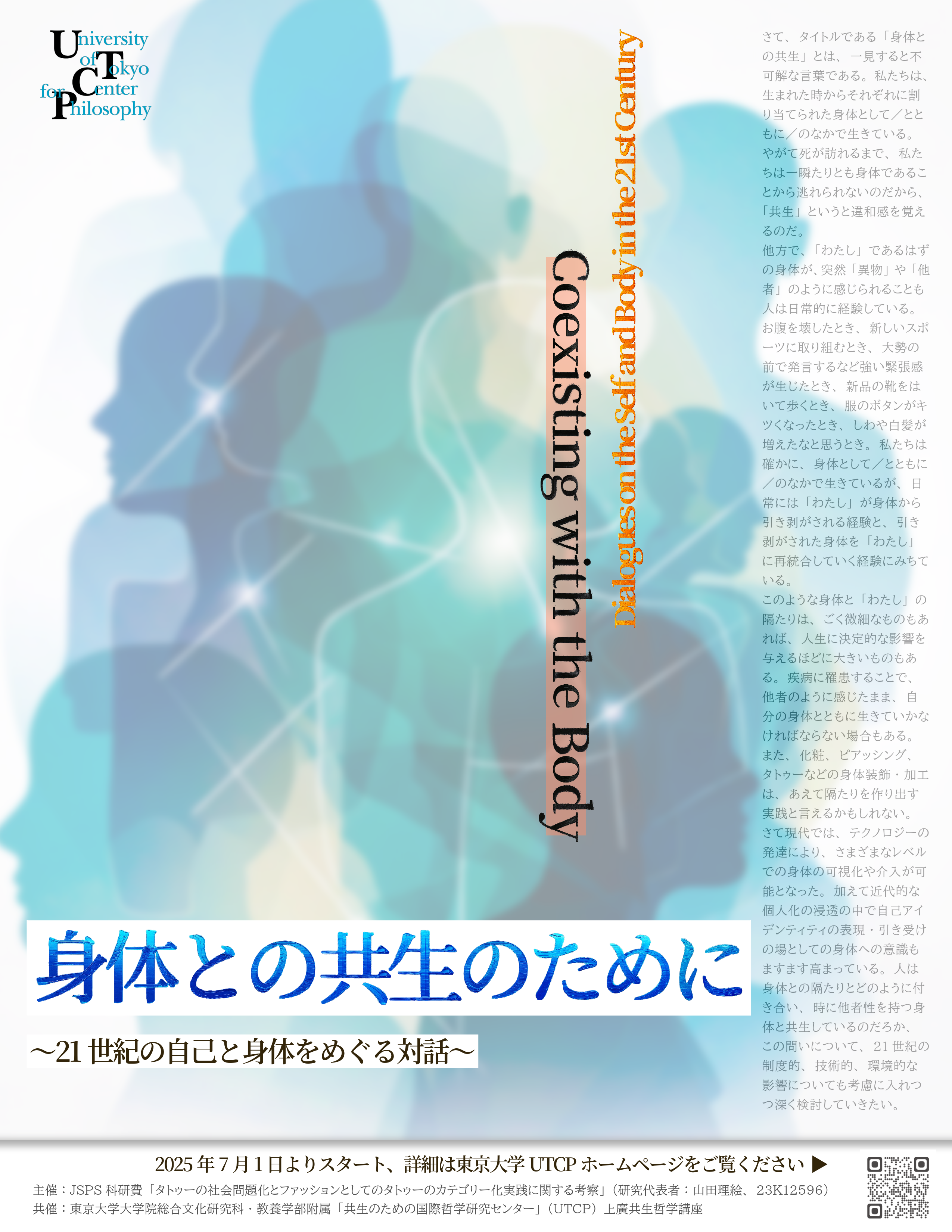
Coexisting with the Body: Dialogues on the Self and Body in the 21st Century
17th session "The Sociology of Self-Harm: 'Embodied Emotions' and the Fate of Narrative"
Starting in July 2025, we will launch a new series titled "Coexisting with the Body: Dialogues on the Self and Body in the 21st Century." This series is co-organized by a JSPS KAKENHI (Grant-in-Aid for Scientific Research) project (Grant Number 23K12596) and the University of Tokyo Center for Philosophy (UTCP).
For this series, we will welcome speakers who are engaged in diverse research and activities broadly related to the concept of the "body" across various specialized fields, including philosophy, anthropology, sociology, medicine, psychology, fashion, theater, and music.
Through their lectures and interviews, we aim to explore questions such as "How do we engage with the alterity of our own bodies?" and "What factors define the unique perspectives on the body in contemporary society?" We also hope to foster discussions that can lead to insights for addressing the various conflicts people face regarding their bodies in modern times.
17th session "The Sociology of Self-Harm: 'Embodied Emotions' and the Fate of Narrative"
Speaker: Tadato Sawada (Special Research Fellow, Institute for Coexistence and Socio-Cultural Studies, Otsuma Women’s University)
Date: 2:00-4:00 PM, Saturday, March 28th, 2026
Location: EAA Seminar Room. Bldg 101, University of Tokyo KomabaⅠCampus and Zoom
Register(In-person): Please register via Google Form
Register(online): Please register via Zoom
What does it mean, ultimately, to “understand” self-harm? What exactly is it that we seek to understand? Is it the various functions or effects that self-harm may have?
For example, when someone sheds tears and we wish to understand the meaning of those tears, we are not necessarily trying to grasp their “function” or “effect,” nor do we believe that understanding them consists in doing so. To understand the meaning of another person’s tears is, rather, to recognize that within the course of that person’s life, at that particular moment, there were “words” that could only be lived in the form of tears—and to attempt to listen to them as an irreplaceable narrative.
Might the same be said of self-harm? To understand the self-harm that a person lives through may mean attempting to listen, as narrative, to the “words/voice” that, at that moment in that person’s life, could only become embodied in the act of self-harm.
In this presentation, I explore this possibility by examining the relationship between several participants’ “life stories” (based on interview research) and their “embodied narratives.” I aim to consider the trajectory of another kind of story—one in which emotions seek to speak not only through the subject (the human agent) who narrates, but through the body—and to reflect on how such narratives might be cared for.
Tadato Sawada
Special Research Fellow, Institute for Coexistence and Socio-Cultural Studies, Otsuma Women’s University. After completing the doctoral program in Sociology at Keio University’s Graduate School of Human Relations and serving as a JSPS Research Fellow, he assumed his current position. Ph.D. (Sociology).
His research focuses on the sociology of emotions and action. Through qualitative studies on self-harm, including wrist-cutting, he examines what it means to be compelled to live with “nameless emotions” and “incomprehensible acts”—not only for others but also for oneself. His work explores their narrative and embodied dimensions, and considers, from a sociological perspective, the modes and ethics of response—such as care, sacrifice, and forgiveness.
Organized by:
JSPS KAKENHI "A Study on the Social Problematization of Tattoos and the Categorization of Tattoos as Fashion" (Principal Investigator: Rie Yamada, Grant Number 23K12596)
Co-organized by:
University of Tokyo Center for Philosophy (UTCP), Uehiro Research Division for Philosophy of Co-existence