

|
Title: | Coexisting with the Body: Dialogues on the Self and Body in the 21st Century, 10th session "What Are Health and Illness? : Centering a Phenomenological and Hermeneutic Approach"Registration Required |
||
|---|---|---|---|---|
| Date: | 2:00-4:00 PM, Thursday, December 18th, 2025 |
Place: | Room 24. Bldg.101, University of Tokyo KomabaⅠCampus and Zoom |
|
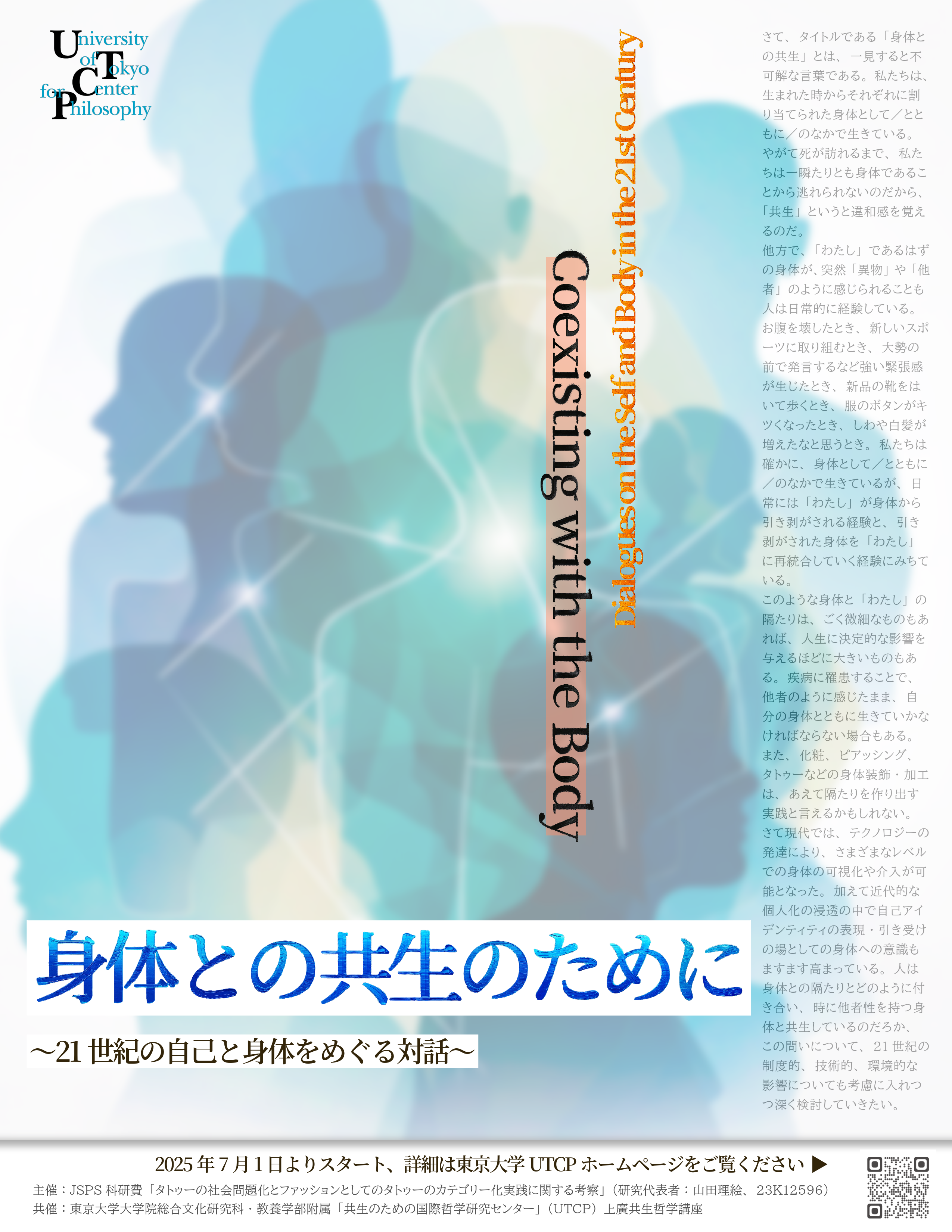
Coexisting with the Body: Dialogues on the Self and Body in the 21st Century
9th session "What Are Health and Illness? : Centering a Phenomenological and Hermeneutic Approach"
Starting in July 2025, we will launch a new series titled "Coexisting with the Body: Dialogues on the Self and Body in the 21st Century." This series is co-organized by a JSPS KAKENHI (Grant-in-Aid for Scientific Research) project (Grant Number 23K12596) and the University of Tokyo Center for Philosophy (UTCP).
For this series, we will welcome speakers who are engaged in diverse research and activities broadly related to the concept of the "body" across various specialized fields, including philosophy, anthropology, sociology, medicine, psychology, fashion, theater, and music.
Through their lectures and interviews, we aim to explore questions such as "How do we engage with the alterity of our own bodies?" and "What factors define the unique perspectives on the body in contemporary society?" We also hope to foster discussions that can lead to insights for addressing the various conflicts people face regarding their bodies in modern times.
9th session "What Are Health and Illness? : Centering a Phenomenological and Hermeneutic Approach"
Speaker: Hoko Nakagawa(UTCP Project Researcher)
Date: 2:00-4:00 PM, Thursday, December 18th, 2025
Location: Room 24. Bldg.101, University of Tokyo KomabaⅠCampus and Zoom
Registration
In person: Please register via Google Form
Online: Please register via Zoom
What are health and illness? In an era marked by a “health boom,” it seems increasingly necessary to reconsider this question. To be sure, receiving a “normal” result on a medical checkup can be taken as one indicator of health. Yet if a person feels discomfort, pain, or difficulties in daily life, it becomes unclear whether their condition can truly be called healthy. Similarly, foods widely regarded as “good for health” cannot automatically be assumed to benefit everyone; they must be examined case by case. This is because what counts as healthy differs from person to person depending on factors such as lifestyle-related diseases, food allergies, preferences, constitution, and various other physical–psychological elements.
As suggested above, the concepts of health and illness are often used in everyday life despite their ambiguous meanings. In contrast, for example, the German philosopher Hans-Georg Gadamer (1900–2002) understands health not as something captured by “measuring standard values,” but as “a state of inner harmony and attunement with oneself” (from The Enigma of Health / Verborgenheit der Gesundheit, 1993). Gadamer’s interpretation of health is grounded in his broader philosophical reflections on life and human existence.
In this presentation, taking a phenomenological and hermeneutic approach that emphasizes attentiveness to individual experiences and phenomena themselves, I will reconsider the phenomena of physical and mental health and illness from an ontological horizon. In doing so, I will draw on the thought of Gadamer as well as Martin Heidegger, Bin Kimura, Karl Jaspers, and others. I hope to examine and deconstruct the dichotomous framework of “health vs. illness” by using keywords such as gradation, relativity, individuality, and subjectivity.
I will avoid technical philosophical jargon as much as possible so that people from various fields can engage in open, relaxed discussion. Please feel free to join us.
Hoko Nakagawa
Project Researcher, UTCP.
She received her Ph.D. in philosophy for research on Martin Heidegger (2017), after which she became interested in connecting philosophy with social practice and entered medical school as a transfer student (2020).
While exploring interdisciplinary approaches that link medicine and philosophy—such as philosophy of medicine and bioethics—she has begun to develop an approach that reexamines medical phenomena (health, illness, aging, pain, immunity, etc.) from an ontological horizon.
Her publications include the monograph Ab-grund: Thrown Projection (der geworfene Entwurf) in Heidegger (Shōwadō, 2018); “The Nature in Disease K. Jaspers, M. Heidegger, Bin Kimura” (Menschenontologie, No. 23, Kyoto University, 2023); and “How do doctors perceive fetal therapy? - From interviews with fetal therapy specialists” (Journal of Japan Association for Bioethics, vol. 35, 2025), among others.
Organized by:
JSPS KAKENHI "A Study on the Social Problematization of Tattoos and the Categorization of Tattoos as Fashion" (Principal Investigator: Rie Yamada, Grant Number 23K12596)
Co-organized by:
University of Tokyo Center for Philosophy (UTCP), Uehiro Research Division for Philosophy of Co-existence